Filmed, produced and narrated by Marie-Jo - and shown at a Stanford student Film festival.
In memoriam.
Filmed, produced and narrated by Marie-Jo - and shown at a Stanford student Film festival.
In memoriam.
Recent short video feature members of our team: Nelis, Madam K. and CEO (Chief Eternal Optimist) Mesye Toma, sending words of appreciation to you, the reader.
Haiti Direkt from the Mountain:
 |
| The initial construction, assembling PVC piping. Watch out for wandering cows... |
Might Did Not Make It Right
Part 1
by Marie-Josée Mont-Reynaud, March 2002
The author, age 15, in rural Haiti, learning from and with the youth of Mon Bouton
American Marines entered Haiti in 1915 in order to maintain peace and help stabilize the Haitian government. They occupied Haiti until 1934, controlling the Republic through a puppet Haitian government. This Occupation failed to achieve its goal of building a democratic government that would last after its forces departed. This paper ascribes this failure to the predominantly military character of the occupation, which undermined the sovereignty of the Haitian Republic and the development of democracy.
Many American officials involved in the Occupation believed their efforts were to aid in the peaceful governance of the country because Haitians were deemed incapable of such. American attitudes toward Haitians were typically paternalistic, claiming, for example “these people had never heard of democracy and couldn’t have comprehended it had they heard.”[1]

This paper maintains that Haitians did not want foreign intervention; Americans were in Haiti because they wanted to be there, not because they had been invited, and they remained there only by military force. The will of the Haitian people was not expressed because Haitian political sovereignty was constrained by the American military. This survey of the literature shows that military force was used to impose a democracy by undemocratic means. Elections under the Occupation were rigged; a treaty was passed by force; martial law was declared; military tribunals were held; the press was censored; the Haitian Senate was dissolved; the constitution was changed by an unconstitutional plebiscite, and opposition was violently repressed.
These procedures reveal the ideology of the Occupation forces that "Might could Make Right" in Haiti.
(Part 2, in forthcoming Blog post)
Food doesn’t grow on trees…
Food doesn’t grow on trees here. It must be coaxed, nurtured, wheedled, and cajoled out of the dry earth.
Mostly, if you try to grow carrots, the piglets will dig them up; mostly carrots, like mostly everything else, has to be purchased up at the weekly market at the site of old Fort Kampon.
This market, “upstairs," as I quipped, is an hours' hike, depending on if you are Haitian or blan and the time of day. My neighbors are out the door with laden baskets on their heads by 4 a.m. If I make it out before 7, the hike will go faster before the sun gets strong.
Yes, it can take me 2 hours.
The Fort Kampon market is where Madame Andre taught me how to sell rice by the tin can, yon gwo marmite, yon ti mamite.
It was one of those cans from Maxwell House coffee — yes they used small tomato sauce cans, and Maxwell House, coffee tins, precious containers.
And no, you would never, ever throw away a plastic bag!


Clearly, God was in this place.
Let me tell you:
My current hero, the physician-anthropologist-partisan, Italian Carlo Levi, crafted an ethnography of his exile in mountains of Basilicata, Southern Italy, under Fascism. His memoir was Cristo si è fermato a Eboli, — Christ Stopped at Eboli.
Nothing much about Christ stopping here, in these mountains, somewhere, in southern Haiti. At 4,500 feet, give or take. Dr. Levi’s title is better translated as “Christ Never Made it Up Here.”
Mountain? This Haitian hillock. It’s too alive, verdant, earthy, sweaty, breathing…bare footsteps murmuring up and down the paths, Kreyol calling. Perhaps…perhaps, here, on this small mountain, despite the deprivations, the hard-scrabble lives I share…perhaps, here, well — Christ —that notion of redemption through suffering…doesn’t sell well here.
At least, myself, I’m not buying.
Here, there is all-over green, pandanus, kokoye, trees, young and old pea plants…a vast, jungle-y drooping smelling life, a wildness that feels, in contrast to Carlo Levi’s bare village, starving peasants somewhere in 20th century Basilicata, in Italy’s boot, a dried, forsaken, abandoned plaster…
Here, well, on the mountain, well, God is in this place. “And I didn’t know it.” Mon Bouton, Haiti.
Now, I must show you.
Here.
 |
| In Living Color |
 |
| Lives I witnessed, pitied |
 |
| Lives I shared |
 |
| The living earth, verdant, lush vines gripping |
 |
| You could see, if not imagine, forever...Miami! |
 |
| Yes, I am an anthropologist, a seeker, wanderer...and so? |


Introducing My Colleague, Elisee Abraham, aka "Toma"

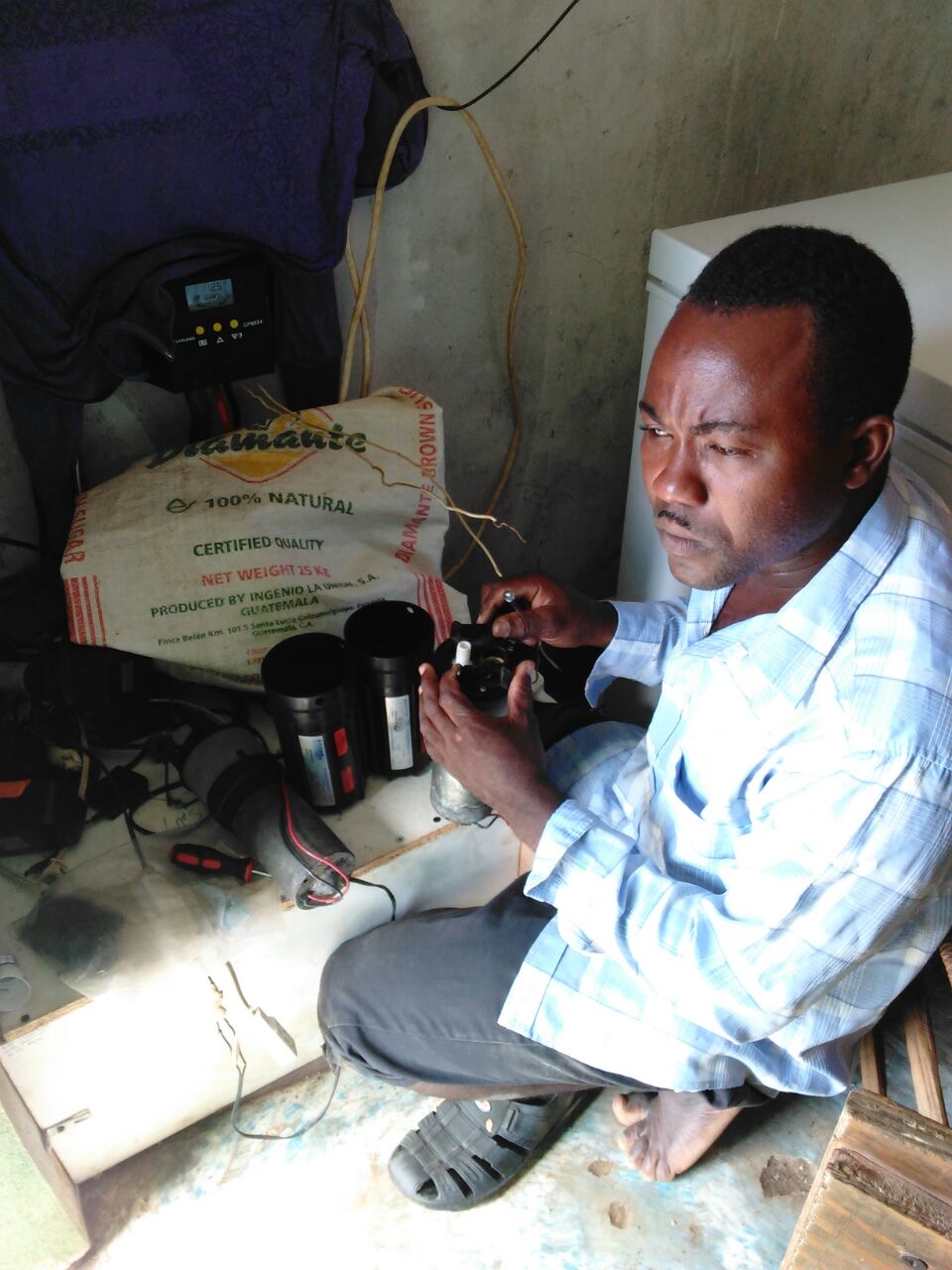
My colleague, Toma, is a Jack-of-all-trades -- if he does not know how to do it, he figures it out. His efforts to support the various objectives of "If Pigs Could Fly - Helping Hillside Haiti ---that is, harnessing solar power to pump water, the school snack program and managing paid work projects in infrastructure and schools --- that and his work as a para-veterinarian have served his community for over 20 years. This is a salute.
Heading for the Hills of Haiti

Twenty-four years ago, as an anthropologist on the first of what would become many sojourns in the mountains of southeastern Haiti, I was initially shocked —then later — charmed by what I saw, heard, felt and witnessed. Charmed? Yes, “Charmed,” since I felt I’d discovered just that, here in anthropological paradise — this mountain world where, as I described it, “The clock had stopped in 1804.”
So, it was a coup de foudre— the beginnings of a love affair with the traditions, techniques and talents of my neighbors and colleagues. Many came to be friends. Yes, there were grudges, debates, hard feelings. I acquired a modest ability, of necessity, in speaking Haitian Kreyol. Is it perhaps not by understanding, but by misunderstandings that a deeper appreciation of the anthropological Other grows? Accordingly, anthropology as science is necessarily a process. In anthropological circles the term is heterology—“The science of the Other— which begins with the apparent incongruities of the voyaging account, the shocks to our own categories, and common sense.” (Sahlins 1995:118)
Given my training in anthropology, I was drawn to what this rural mountain culture had, not what it lacked. I considered, for a long while, the glass half-full, not half-empty, even as some of the children around me had distended bellies, reddish-tinged hair and hollow eyes… For their sturdy hands, at the end of thin wrists, gripped mine with a strength I couldn’t muster. And so, the malnourished sturdy children helped me up the long, winding switch-back, over rocks and slippery soil to our final destination, Mon Bouton.
For a long while, I held to this notion. Half full.
"Things didn’t turn out the way they were supposed to, but what can you do ? You must take life the way it comes at you and make the best of it." (From Yann Martel’s Life of Pi)
Once upon a time when my daughter was still alive, and she was a student at Stanford where I worked - and where I "wrote" the autobiography of Martin Luther King Jr. among other things... I was a compiler, of sorts, let's be accurate.
So perhaps Brother Martin was an inspiration? Listening to all his speeches, putting them in chronological order, and the Prof. Clay Carson edited by efforts...
Learning from King, the Poor People's Campaig and what was then "the Other America," Black, disenfranchised, under-served...
So...To Haiti!
We went to Haiti because she had a report to write in high school about a Caribbean or Latin American country.
My daughter was disappointed when a classmate got Cuba. I told her "Why don’t you choose Haiti ? You speak French Haiti speaks French…"
Well, Haiti doesn’t speak French at least the masses of people don’t and so….
After meeting up with a Haitian foundation at Stanford’s Haas center, we made some connections and studied Kreyol at Staford and went to the mountains of rural, Haiti and fell in love.
We took teams of Stanford students over the following years to learn from and live with the people -- not to help but to learn from because "Help" is a four letter word, and you don’t do that- not when your mother is an anthropologist.
Right. So, I saw as a mother-daughter anthropologist team, like Margaret Mead and her daughher Mary Catherine Bateson...(Aunt Maggie had been my mentor from a distance, as an undergrad at University of Hawaii).
But, it was not to be.
From Levi-Strauss, my hero so long ago:
“Like a city-dweller transported to the mountains, I became drunk with space, while my dazzled eyes measured the wealth and varieties of the objects surrounding me. An anthropological Paradise.”
Over the years, the past 25 years to be precise, of summers and December vacations, at Project Base, our home in those hills, I have finally gotten used to the constant comings and goings, interruptions, greetings — it is impolite not to shout some reply, acknowledgement, greeting, from the path or the window. From wherever you stand.
In my absence, “Project Base” is lived in, managed by, and its gardens, flowers, hibiscus, planted and maintained by Madam Kawolis. In my absence, she plants black beans which cascade over the patio. Food more than flowers.
In my presence, Madam Kawolis. is happy sleeping in the depot, a small separate kabin for storing tools and, well, the stuff that we lot bo dlo (USA) might hoard and forget about in our 2-car garages or basements—oddments of old furniture which could perhaps be used for firewood, but in any case, not to be tossed (where?). Mme. Kawo keeps mayi, corn, in one or another stage of husking or grinding, and banane on their way to or from the “upstairs” (Fort Kampon) or “downstairs” market, in the almost-coastal town of Dabon.
Madame Kawolis is a peddler, or rather, a porter; the banane, the mayi is carried in huge baskets on her head. The baskets are woven nearby. I treasure them. Into the baskets goes produce. Madame Kawo carries her goods “upstairs” as I call it — or rather, upmountain — to Kampon market.
Down and back to Dabon, “downstairs” as I would say, is 6 hours round trip if you are blan (foreigner, visitor — not a skin shade!) Up and back to Kampon is best before dawn — you actually climb faster before sun up! It’s true. This, I learned. Vivere e imparare.
Baskets. One year, I actually fit one in my largest empty suitcase and flew it across the seas, lot bo dlo. It served back in Palo Alto for laundry for many years…My favorite basket.
Until it, like so much else, had to go.

 |
| In Memoriam "May the one whose spirit is with us in every righteous deed, be with all who work for the good of humanity and bear the burdens of others... and take the friendless into their homes. |
 |
| Stanford student team dances the distance |
 |
| Goats at dawn with kids...yawn... |
 Mariejo shells beans, ruins manicure, listens to neighbor, Magali.
 |
| Take a bath once a week whether you need it or not... |
 |
| Hike way up to Fort Kampon, 2001 |


Why Haiti? Why Hunger? Why Indeed?

What? Why? Huh?
After several years trying to find a magic bullet to somehow solve the problems of subsistence farmers in rural Haiti, and trying to understand my own motivations, I came across Alexander McCall Smith's narrator's conclusion. Mma. Precious Ramotswe, in Morality for Beautiful Girls. Like Precious, Ramotswe, I felt could not refuse to help persons in need.
And yes, although Haiti is not (exactly) Africa, it is safe to extrapolate, with Precious R., "Not that you could do everything. Africa was full of people in need of help and there had to be a limit." Haiti has 8 million hungry people (not counting city-dwellers, who manage to eat every day).
So, for myself, in Haiti, I set the limit: just one hillside, just one small mountain, that's all.
So, it happened to be my mazel (luck) to arrive up in Mon Bouton, some 3500 feet above the plain of Leogane. Because of a cup of coffee. (But that's another story.)
Back to basics. Food. Agriculture? First, let’s give you banana fronds…oh damn, no, let Edwige Danticat give you banana fronds—, banane, thickets of pwa nwa, black bean plants taking over because, of course, you cannot EAT flowers, and if you are Haitian, if you are Madame Kawolis, why, you must plant every possible square inch with a food crop…
If you are a blan, a foreigner, like myself, why, in your home country you glory in the green , which is of course everywhere, everywhere, and climbing. Growing.
Earth.
Earth rich.
Earth rich and rotten.